“Days of indulgence”
The Painted BirdThe expression “Days of indulgence” describes the narrator’s imagined system for converting prayer into a measurable store of heavenly credit. After hearing a priest explain that certain prayers could earn from one hundred to three hundred days of indulgence, the boy concludes that the amount accumulated affects life on earth: more prayer should mean greater well-being, while less means more hardship. The idea gives suffering a rule and a remedy. It also turns prayer into a form of survival arithmetic, counted against the boy’s experience of a world where he has little control over what happens to him.
A heavenly account of earthly inequality
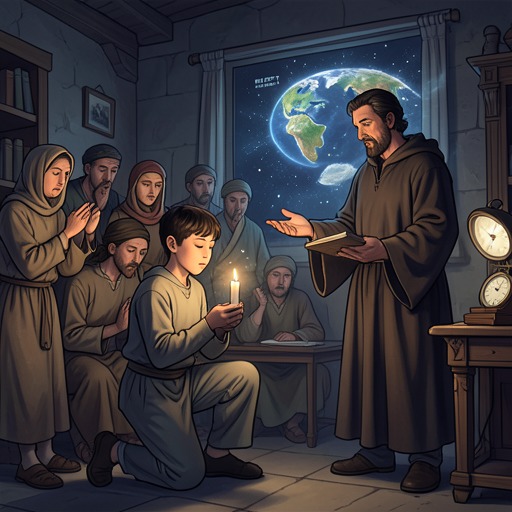
The priest’s explanation prompts the narrator to reinterpret the divisions around him. He imagines that strength and weakness, freedom and enslavement, wealth and poverty, health and illness all follow from whether people have discovered the value of prayer. In his vision, prayers rise from earth to be sorted into individual bins in heavenly pastures. Some bins bulge with accumulated days; others are nearly empty, while unused bins wait for people who have not yet begun to pray.
This model offers the boy more than a promise of personal relief. It makes the human world seem governed by a principle, and therefore potentially just. He stops blaming other people and decides that his own hardship results from having failed to learn the system. If he prays effectively, he believes, a heavenly aide will recognize him and assign him a place where his days of indulgence can collect like sacks of grain at harvest. He imagines his account growing until it needs a bin as large as a church. The scale of that fantasy answers the smallness of his position in ordinary life: he expects that anyone can crush him, but believes prayer may make him unapproachable.
The setting sharpens the appeal of such an orderly account. German occupation adds to the misery of already poor villages, where peasants must surrender scarce crops to regular troops and partisans, and refusal may bring punitive raids. Against this material insecurity, the narrator’s imagined system offers a kind of resource that cannot be seized in the same way as food or shelter. Its promise rests on accumulation, but the accumulated credit belongs to him and, as he imagines it, remains available in heaven.
Learning to accumulate prayer
The narrator approaches the priest as if casually interested and asks to see the prayer book. He quickly identifies prayers marked with the largest number of indulgence days and asks to learn them. The priest is surprised by his selective preference, but reads the prayers repeatedly until the boy has memorized them. The narrator considers this preparation for a new life: he believes that the days of punishment and humiliation will soon be over because he has found the necessary method.
He then gives prayer nearly all his available attention. He recites rapidly, sometimes including a prayer worth fewer days so that heaven will not think he has neglected the humbler ones. This qualification reveals how literally he treats his private system: he calculates the value of each prayer but worries that maximizing the total too openly might amount to outwitting God. He imagines the days rising in a heavenly account and pictures prayers flying upward like sparrows, drawing the approving attention of saints and bringing his name closer to the heavenly throne.
The account also supplies a way to measure persistence. When suspended as punishment and threatened by Garbos’s dog, Judas, the narrator remembers the prayers and continues reciting rather than giving up. He imagines thousands of days passing through the thatched roof toward heaven. After Garbos takes him down, the boy continues praying, certain that his growing total may soon prompt some improvement in his life. The scene makes the belief concrete: prayer does not remove the immediate danger, but gives the narrator a task and a count to hold onto within it.
Prayer under persecution
Garbos does not understand the boy’s constant murmuring. He suspects that the narrator is using spells against him, while the boy conceals the real explanation. He fears that Garbos might prevent him from praying or, as a more established Christian, use his standing to interfere with the prayers’ heavenly effect. Meanwhile, Garbos beats him more often, interpreting delayed answers as insolence and fearing that the boy may complain to the priest. Prayer and punishment consequently become intertwined in the boy’s daily life: he recites while enduring the abuse and treats the credit as something that pain cannot take away.
The narrator adapts his prayers to the demands of endurance. While hanging, he promises himself another ten or twenty prayers, then sets a further target once he has reached it. At other times he measures the effort through larger totals, using a thousand days of indulgence as the imagined price of straightening a leg or resting an arm. These figures do not describe a change in his circumstances; they show how thoroughly the heavenly account has become a private instrument for organizing time and effort. As the routine continues for months, he becomes physically more accustomed to it, while still believing that each additional prayer may save his life at any moment.
That conviction persists despite the absence of perceptible results. On Corpus Christi, while Garbos is at church and the narrator remains behind, the boy reasons that his store of prayers could rival that of many younger saints. He acknowledges that the prayers have not produced an observable change, yet concludes that they must have been noticed in heaven, where justice governs. Acting on that assurance, he sets out for the church and waits in a concealed corner for an opportunity to enter through a side door. The scene carries the belief from private counting into a physical approach to the institution from which the teaching came.
Meaning and limits
The narrator’s imagined account transforms a theological explanation into a child’s theory of causation. It provides a vocabulary for hope, a structure for enduring repeated punishment, and a way to imagine that the present need not determine the future. Its ledgers and bins borrow the logic of earthly accumulation, but relocate the wealth beyond reach of the village’s immediate power relations. The boy believes that prayer can restore an order that his daily experience otherwise denies him.
At the same time, the episode preserves the distance between belief and evidence. Prayer sustains the narrator’s expectation and shapes his actions, but the account does not establish that heaven intervenes or that his condition improves because of it. He continues to trust the system precisely when its results remain unseen. “Days of indulgence” therefore marks both a promise of justice and the precarious means by which the narrator makes endurance imaginable: a growing total in an unseen account, set against a present that offers no reliable protection.